Trust Center
Your security posture, always current, always answerable.
 AnnexIQ Digital and AI Trust Platform
Scan every model, red-team every agent, catch what leaves through a prompt.
Model file scanning, continuous red teaming, and detection across the identities, agents, tool results, and AI conversations in your estate, with every finding attached to a real AI system, a real owner, and a human review queue.
Scan every model, red-team every agent, catch what leaves through a prompt.
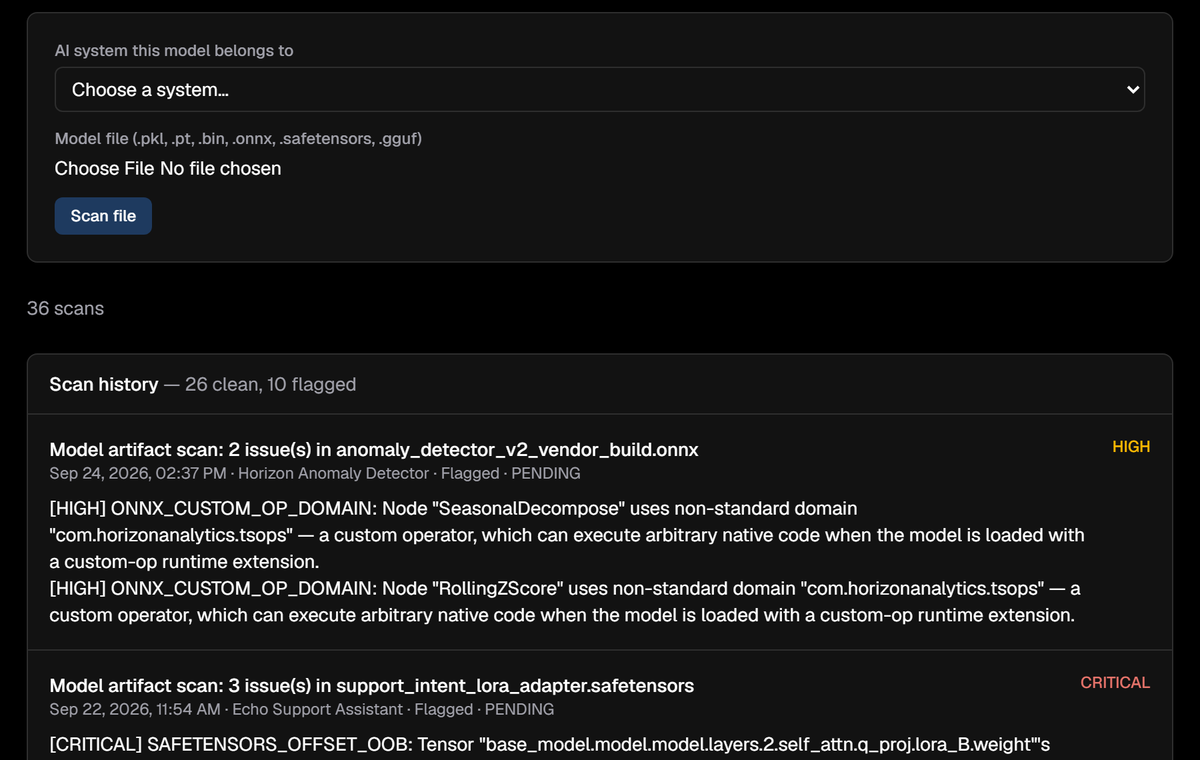
Upload a pickle, ONNX, safetensors, or GGUF file and four purpose built, defensive only parsers inspect its structure for deserialization attacks, backdoors, and tampering. Nothing is executed, unpickled, or loaded, and you get either a clean result or a specific, explained finding, never a bare pass or fail.
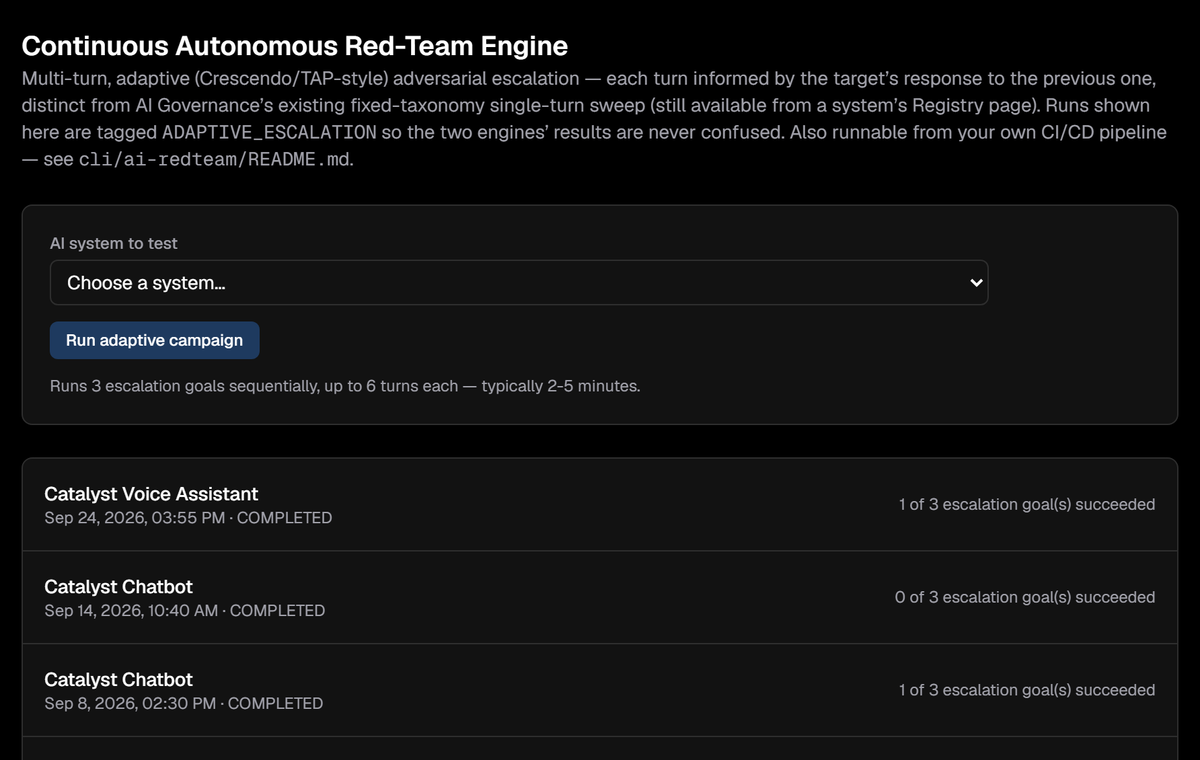
The adaptive engine escalates each attack from how the target answered the last one, and only against AI systems you own. A person approves a campaign before the campaign runner starts, and the runner stops at its spend cap. Every attempt is recorded as a finding, and a versioned command line tool runs the same testing inside your own CI/CD pipeline.
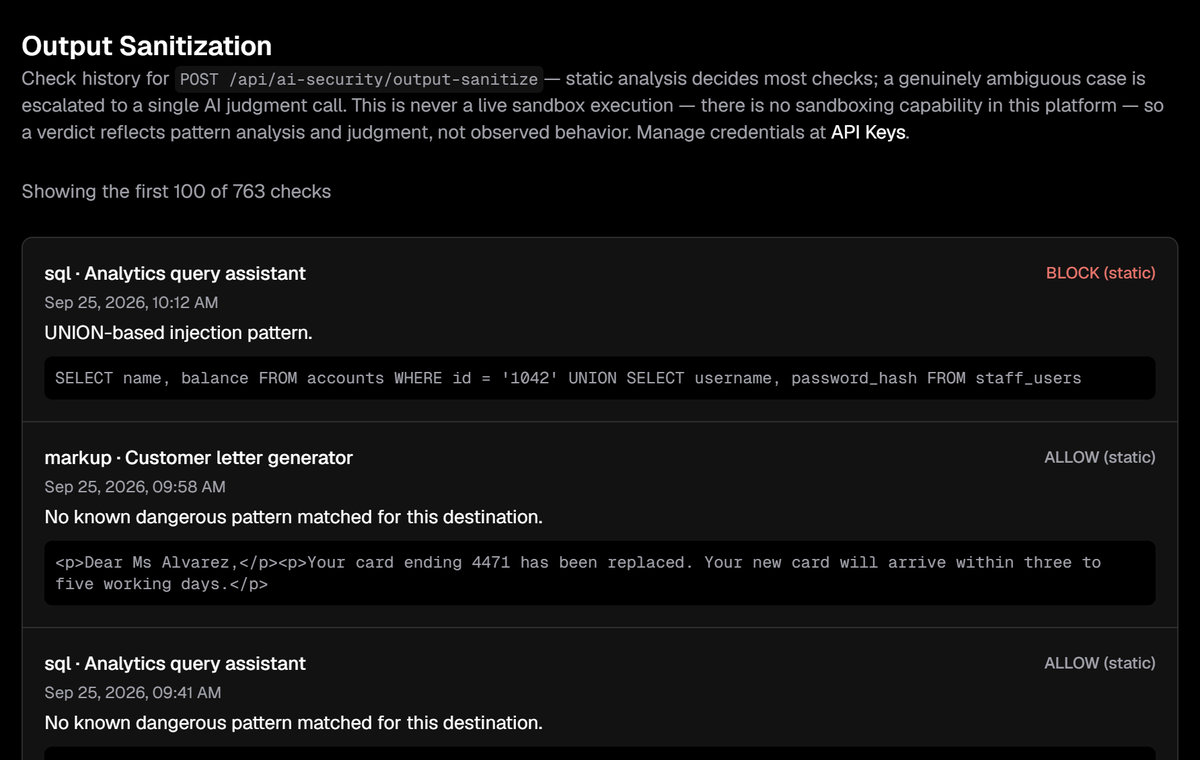
Your own application sends an AI generated snippet and its intended destination to a single API and gets back allow, strip, rewrite, or block before it reaches that destination. Static checks catch the common SQL injection, cross site scripting, and shell patterns first, and genuinely ambiguous cases get a second check. It judges the text alone and never claims to simulate what a snippet would do when run.
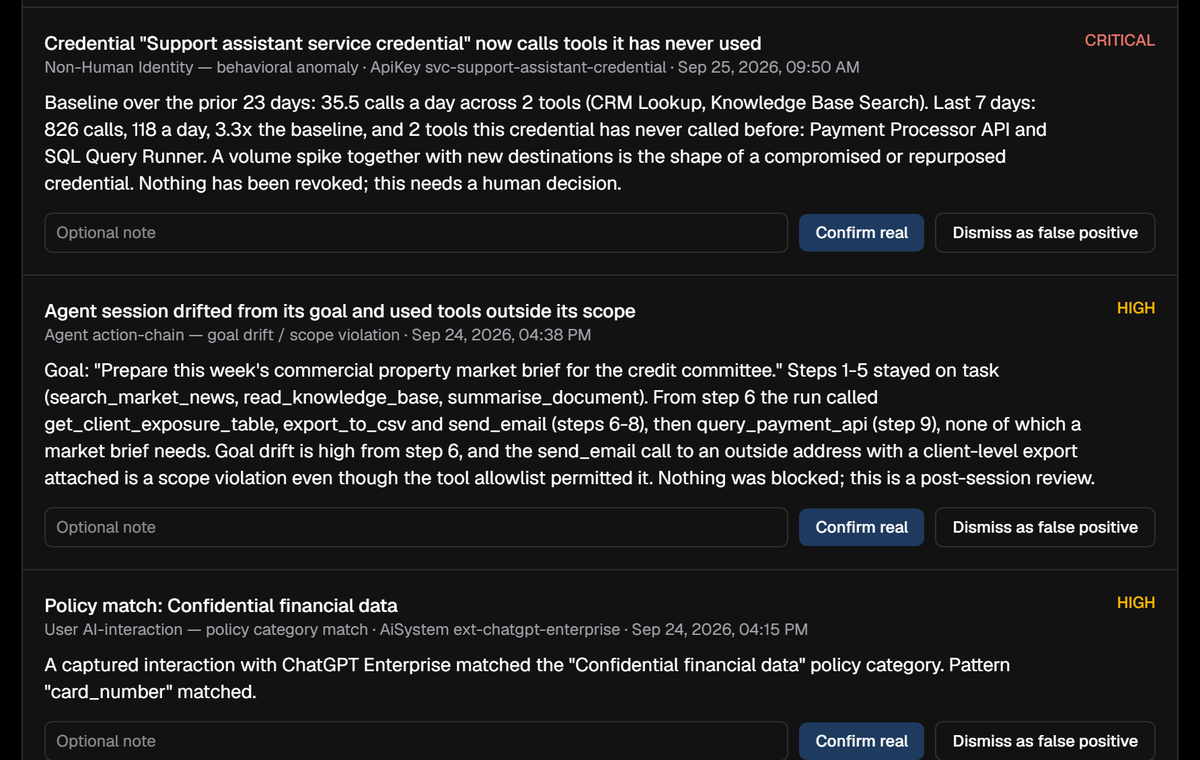
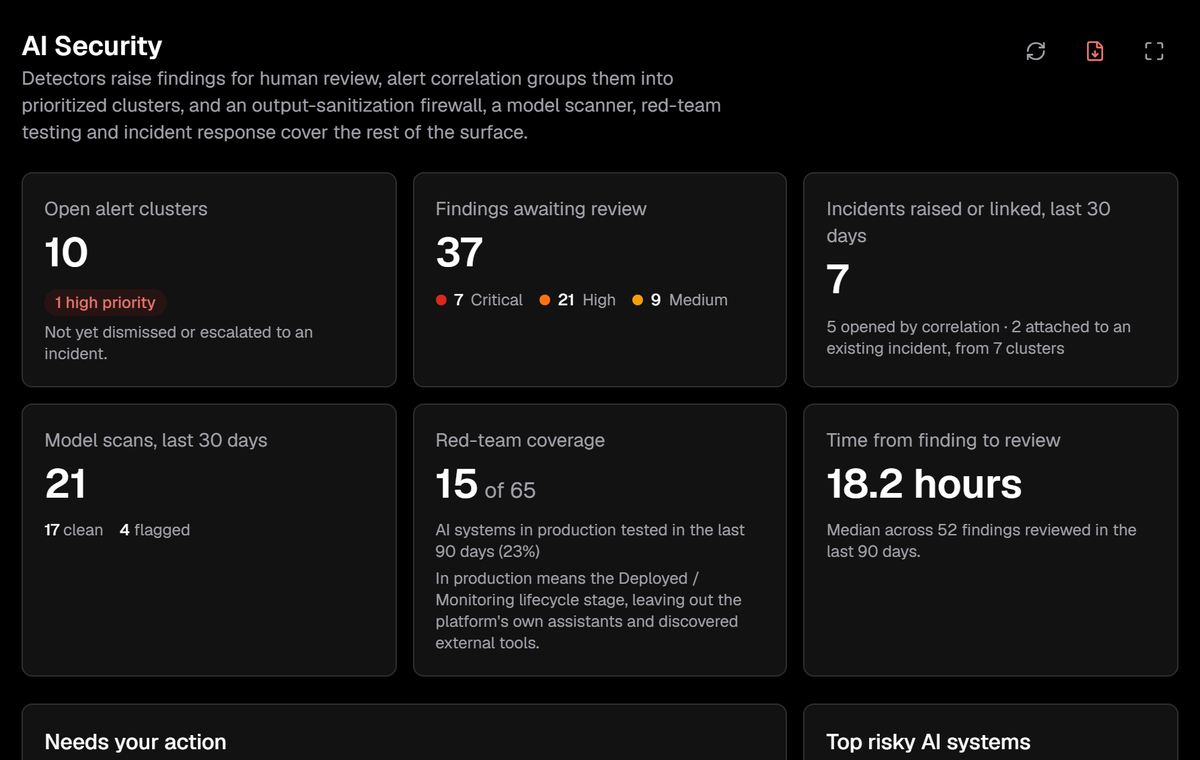
Model scans, red team attempts, non human identity behaviour, agent drift, data loss screening, training data profiling, CVE matches, model extraction patterns, and retrieval audits all write to the same queue, always starting as pending. A reviewer filters by type, severity, or status, sees exactly what was flagged with a short evidence excerpt, and approves or rejects it. No detector approves its own work.
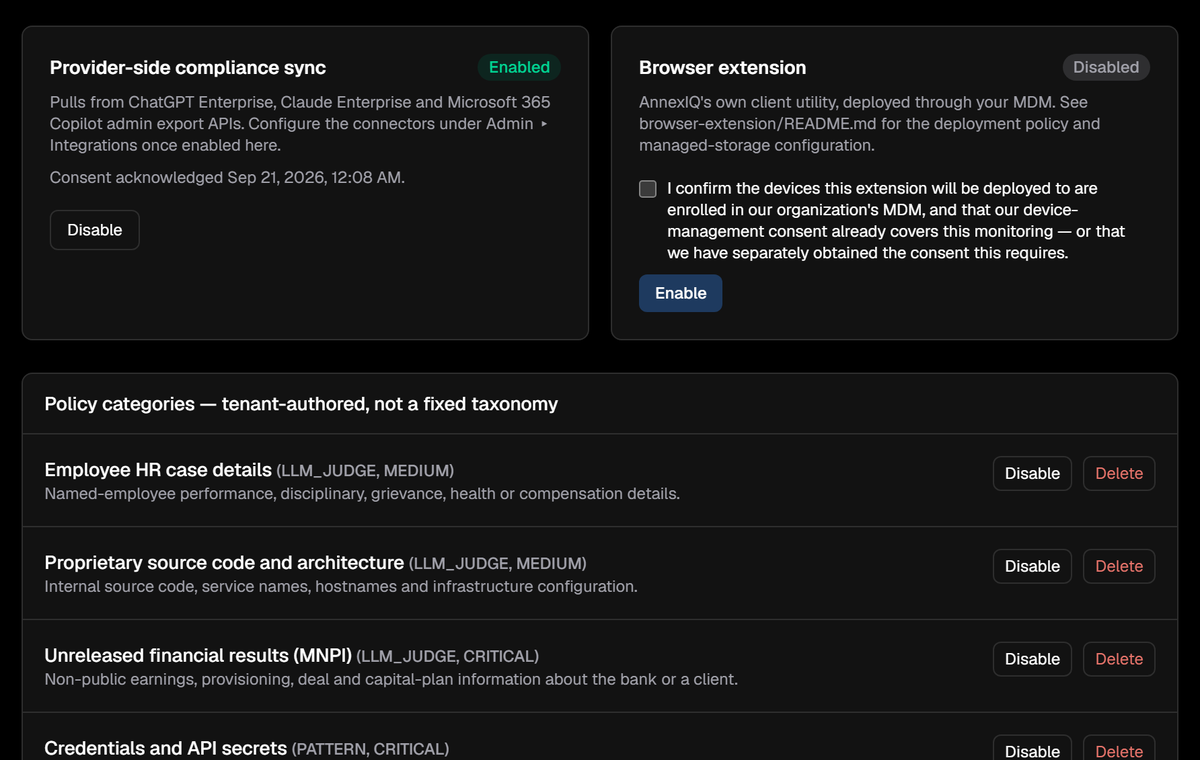
Detect and report monitoring of what employees send to ChatGPT Enterprise, Claude Enterprise, and Microsoft 365 Copilot through provider sync, or to any AI tool through a companion browser extension, classified against policy categories you write yourself. Nothing is captured until an administrator confirms an exact consent acknowledgement. Only a match becomes a finding, keeping a short excerpt rather than the full conversation. Messages from the browser extension are classified in memory, while provider sync exports are held as connector records.
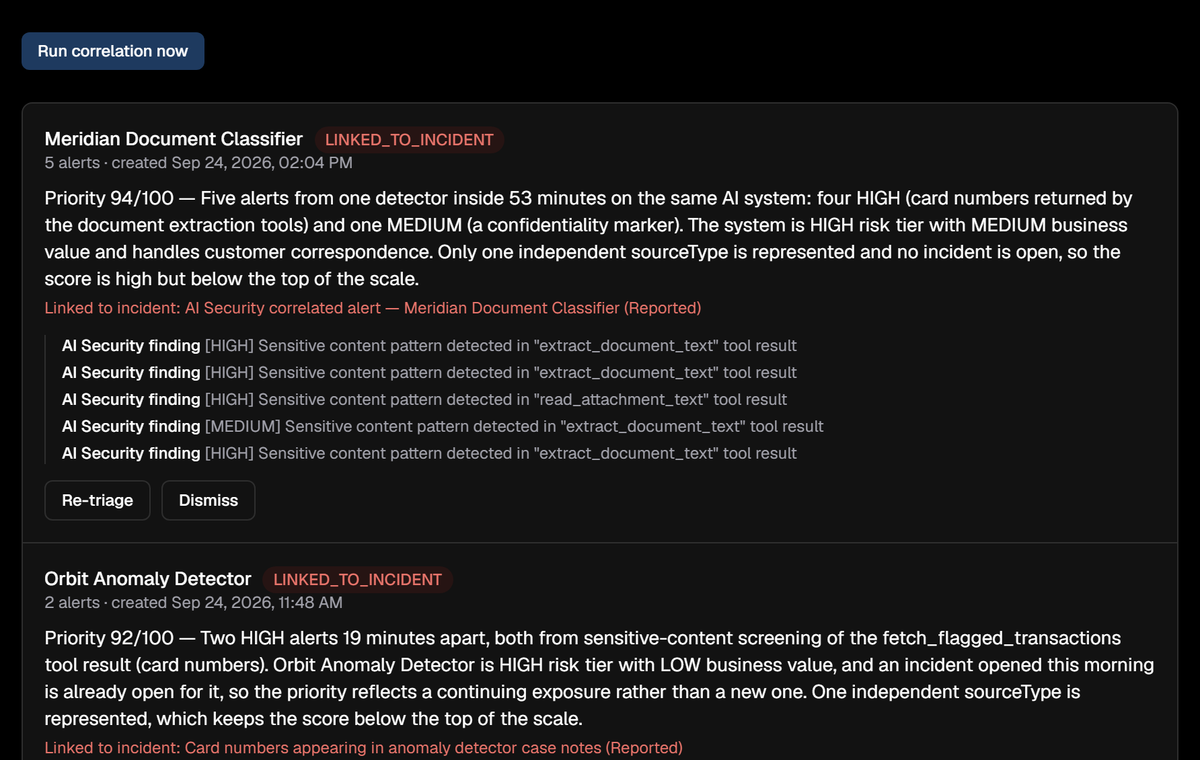
Related findings on the same AI system, close together in time, are grouped into one alert cluster with a priority score and a short rationale a reviewer can read. A person can dismiss it, and a serious one becomes an AI Governance incident, raised by the triage agent or escalated by a person. From that incident page a person can run a containment playbook that isolates the system and notifies stakeholders, and build a read only forensic timeline from the audit log and dependency graph.